FROM THE GREAT MEDITERRANEAN COMFORT FOOD TOUR
“A rollicking culinary adventure seasoned with a dash of history, a sprinkling of heart-warming characters, and a liberal shot of humor.”
Jackie Smith, author of TravelnWrite
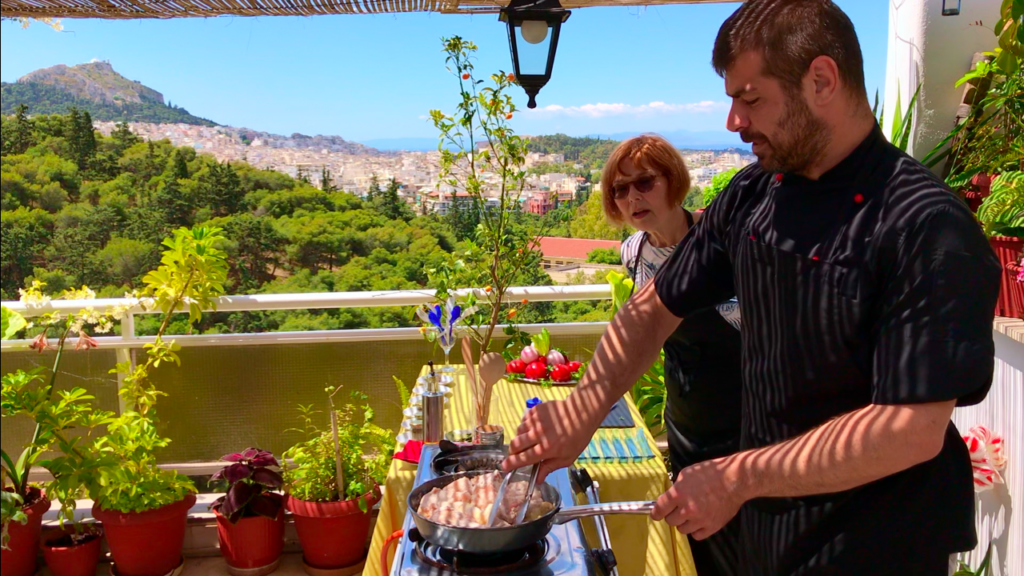
I spent 161 days sampling the most scrumptious fare of Greece, North Macedonia, Kosovo, Albania, Montenegro, Bosnia, Croatia, Italy, France, and Spain. To my surprise, far from guarding their secret recipes, cooks everywhere opened their kitchen doors to me and shared every detail.
Some dishes — Holy Thursday snails, for instance, and Italy’s beloved horsemeat — might not appeal to everyone. Most foods I tried were delectable, including moussaka and various rich flaky pastries stuffed with cheese and spinach-like greens such as blitva and nettles. One Albanian eatery brought in my grilled fish on the back of a horse. Now that’s good presentation.
These recipes continue to be handed down so each generation can help the next endure the dark times, celebrate joys, and give everyday comfort to one another. They’re needed now more than ever — as is the joy of connecting with people over a marvelous meal.
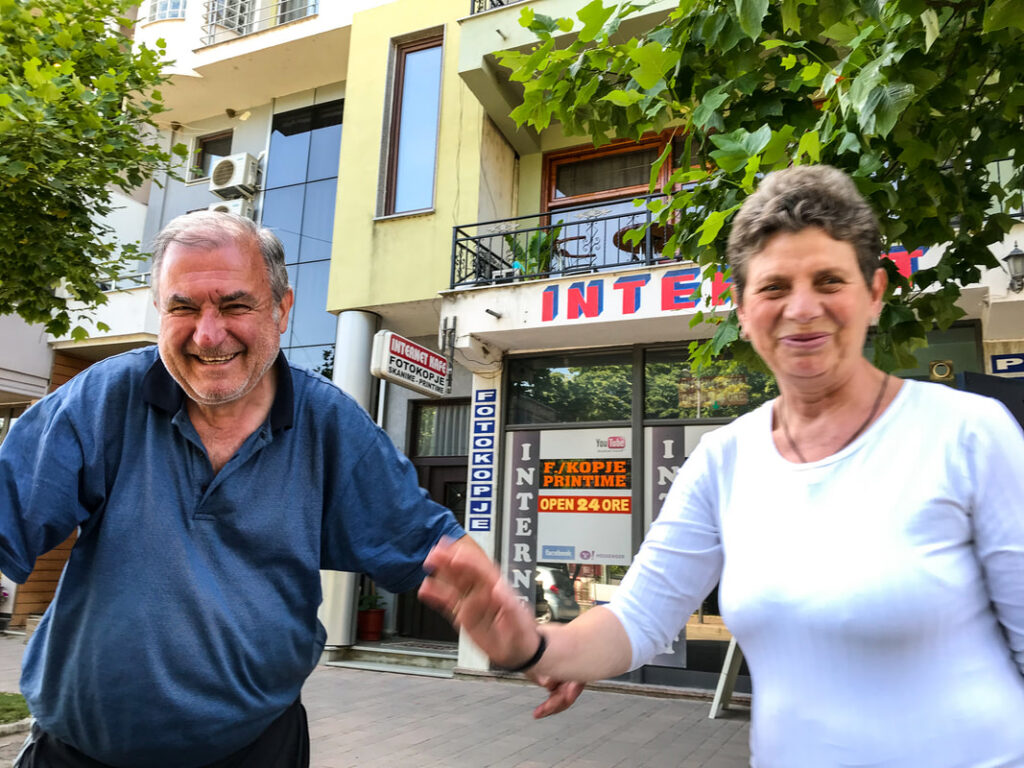
I wrote about all my most memorable meals in my book The Great Mediterranean Comfort Food Tour, and I’ve assembled all the recipes I collected here, identified by chapter, so as you read the book you can make them — or simply enjoy imagining yourself in a far-off land, trying them for the first time.
CHAPTER 2:
VICTOR’S CLASSIC ANDALUCíAN COLD SOUPS
Gazpacho (Seville)
Serves 6
1 kilo (2.2 lbs.) of ripe tomatoes
half of a medium Italian green pepper
half of a small cucumber
1 small garlic clove
6 tablespoons of extra virgin olive oil
2 tablespoons of sherry vinegar
1 leveled dessert spoon (3/4 teaspoon) of salt
Cut off the tops of the tomatoes and then cut them into quarters. Chop the pepper and the peeled cucumber. Add all vegetables to the blender. Cut the garlic in half to remove the core, peel it and put it into the blender too. Add the oil, the vinegar and the salt. Blend until puree texture. Pass this mix through a sieve to remove all seeds and skin.
Let it cool before serving. Serve in a bowl or add some cold water to get a drinkable mix to serve in a glass.
Decorate with diced cucumber and green pepper if you like.
CHAPTER 4
HOHLI BOURBOURISTI / SNAILS IN ROSEMARY
Yannis, proprietor of Perperas, Chania, Crete
Snails are everyday fare in Crete, the local equivalent of American burgers or British fish and chips. During the 40-day Lenten fast, when people are expected to refrain from eating meat, fish, even dairy, it’s OK to consume snails and shellfish; they’re exempt on the technicality of not having a backbone. It’s customary to eat snails on Holy Thursday, which is when Yannis very kindly agreed to let me come into his kitchen and watch how he made hohli bourbouristi.
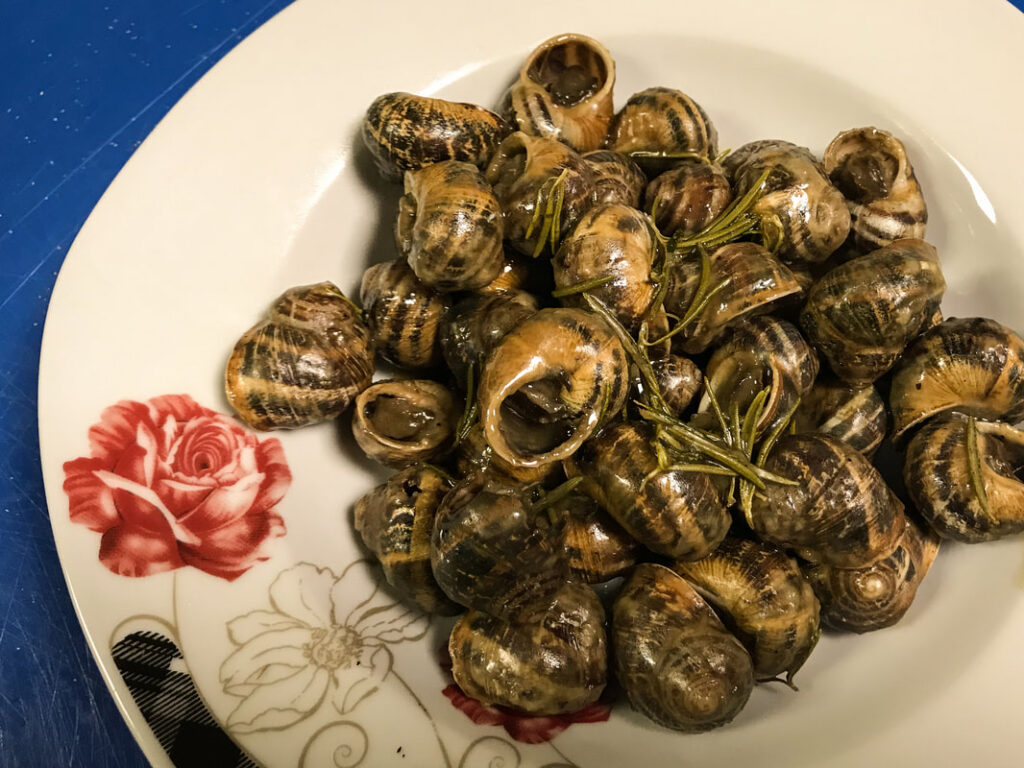
Rinse 30 large, clean snails in water, then dust them with a third of a cup of flour.
Pour a quarter of a cup of olive oil into a frying pan and set it on the burner.
As the oil warms, press the fleshy foot of each snail into salt then set it in the pan. “They go in ‘face down,’ as we say,” Yannis told me. “The name bourbouristi comes from the Cretan abouboura, which means ‘face down.’”
When the snails are sizzling, pull leaves off of two sprigs fresh rosemary and sprinkle them on top, adding a pinch of pepper.
Pour half a cup of strong red wine vinegar over everything, and let it cook for about three minutes until the liquid reduced to a thick sauce. Serve at once.
CHAPTER 7
WILD GOAT
Zisis Popi, Popi’s Restaurant, Ikaria Greece
When I came for a cooking demonstration, Zisis explained the meat was super fresh, having been butchered that very morning. He and his mother raise their own goats in a grassy pen beside the restaurant’s vegetable garden.
Start with about 2.25 kilos (5 lbs.) of meat. Because wild goat is so lean, formal cuts such as loin and shoulder aren’t practical; instead you make “village cuts,” dividing the meat any way you can, so long as it winds up a size that’s roughly suitable for cooking.
You add lots of salt, pepper, and about three quarters of a cup of olive oil.
You cook the meat in a ceramic pot at 200 degrees Celsius (400 degrees Fahrenheit) for an hour and a half to two hours. The cooking brings out the meat’s natural juices, but check it a few times and if it seems dry, add a little vegetable broth.
When the meat is tender and the smaller bones practically liquified, you take it out of the oven and sprinkle it with fresh herbs, especially fresh oregano. Serve at once.
CHAPTER 8
CORFU “PASTITSADA” WITH FREE RANGE ROOSTER AND PASTA
Chef Michail, EatWith, Athens, Greece
Start with one or two young, free-range roosters, under a year old, about 2.5 kilos (.5 pounds) in all. (If you’d like to use up an older bird, marinate overnight in red wine and olive oil. You can substitute free-range chicken if you wish.)
Cut rooster into pieces, salt, massage salt into the meat. Dredge with flour and brown in hot skillet.
While the rooster is browning, heat another pot with plenty of olive oil. Add 3 chopped red onions, and 6 minced cloves of garlic. Pour in a glass of dry white wine. Add 5 grated tomatoes, a few tablespoons of tomato paste for more color, and a large bunch parsley, chopped fine.
The spices are to taste. Michail uses five to six bay leaves, about half a teaspoon of cinnamon, and ¾ of a teaspoon each of cumin, oregano, black pepper, nutmeg, and sweet red paprika. Stir, taste, and adjust to your own preferences.
Let the pot simmer for an hour. Towards the end of that hour, heat up a large pot of water and cook the pasta. The pasta traditionally used in this dish is bucatini, like fat spaghetti only tubular, with a hollow center. Any thick spaghetti or penne will work fine.
In a large ceramic pot, sprinkle about a half a cup mizithra cheese; you can substitute Parmesean or any dry, hard cheese. Add cooked spaghetti to the pot, spoon the rooster and some of the sauce on top. Hold the rest of the sauce to pass at the table. Bake the rooster for 15 minutes in an oven that’s 190 Celsus, 375 Fahrenheit. Serve and enjoy.
CHAPTER 9
FRAPPES & FREDDOS: Greek Hipster Coffees
Athanasia, Thermaikos Bar, Thessaloniki, Greece
Everyone in Greece was drinking Turkish-style coffee until a single impulsive moment at a 1957 trade fair changed the nation’s coffee culture forever. The Swiss manufacturer Nestlé had come to the trade fair in Thessaloniki in order to promote instant Nescafé and a short-lived product involving chocolate milk made in a shaker. One day a Nescafé employee called Dimitrios Vakondios was desperate for a jolt of caffeine but couldn’t find any hot water. On impulse, he borrowed the shaker from the chocolate milk rep and mixed Nescafé instant coffee with cold water and ice. The idea of iced coffee was shockingly radical — yet irresistibly alluring in Greece’s warm climate. Suddenly everybody in Thessaloniki wanted to try it, and soon iced instant coffee became the drink of choice for younger, trendier Greeks everywhere.
This revolutionary drink was dubbed the frappé (from the French “frapper,” meaning to hit, referring to the ice smashing around in the shaker). It can be served with varying amounts of white or brown sugar, with or without condensed milk, and — if you really want to feel the love — a scoop of ice cream.
The frappé reigned supreme until the 1990s, when it was overtaken by the freddo, a similar iced drink made from the classier Italian espresso. It can of course be configured to any degree of sweetness, and if you want milk, you ask for a freddo cappuccino.
Frappé Recipe: Mix up a little water, two teaspoons of Nescafé, and four teaspoons of sugar. Use a blender to beat it to a creamy consistency, add ice and a little condensed milk, stir, then top it up with a bit more water.
Freddo Recipe: The process is the same but with one or two shots of espresso in place of the instant coffee.
CHAPTER 9
KATERINA’S MOUSSAKA
Taverna Giannoula, Thessaloniki, Greece
Makes enough for 16 large servings, using the generous cut served in the restaurant. For smaller crowds, reduce the proportions in half and enjoy the leftovers (if any).
Olive oil
1 lg. onion, grated
2 tomatoes
1 kilo (2.2 pounds) of ground beef
10 to 12 eggplants (aubergines)
12 to 15 large potatoes
Sunflower oil
Salt to taste
Béchamel sauce
In metric measurements
250 grams butter
250 grams white flour
3 liters fresh milk
Salt to taste
90 grams hard white cheese such as Parmesean
In US measurements
8.8 oz (1 ⅛ cup) butter
8.8 oz white flour
3.2 quarts fresh milk
Salt to taste
3.2 oz hard white cheese such as Parmesean
Brown the onion in plenty of olive oil in a skillet. Puree the tomatoes and strain to remove skin and seeds, which are “not good for the stomach,” says Stavros. Add the meat to the onion, brown it, breaking it up so there are not clumps, then mix in the tomatoes. Add salt to taste.
Meanwhile, peel the eggplants (aubergines), leaving some strips of skin. “This keeps the aubergines together,” Stavros says. “Otherwise they will melt.” Slice eggplants length-wise and fry in plenty of sunflower oil. “It is best the oil for the aubergines is very hot,” Stavros suggests. “It absorbs more slowly.”
Peel and wash the potatoes, slice thin, put in a deep fryer (or in frying pan with plenty of oil). Salt potatoes and eggplant to taste. When they are cooked, remove them from the oil. Grease the bottom of a 35 x 40 cm (14 x 16 inch) pan with olive oil. Layer as follows: potatoes, eggplant, meat, potatoes, eggplant. Top with béchamel sauce dusted with grated cheese.
To make the béchamel sauce, mix a roux of flour and butter. Warm the milk in a separate pan. Add milk to the roux and whisk continuously 20 minutes or until thickened. Pour into pan, smooth, dust with cheese. Cook 50 minutes at 200 degrees Celsius (400 degrees Fahrenheit), or until lightly browned. Wait at least 20 minutes, preferably 50, so the béchamel sauce has time to set before serving. If you can’t wait quite that long, don’t worry, a half-melted topping looks messier but still tastes heavenly.
CHAPTER 13
VICTORIA’S ZELNIK (MACEDONIAN SPINACH PIE)
Bitola, North Macedonia
Crust
In metric measurements
600 to 700 grams white flour
½ teaspoon salt
2 to 3 tablespoons olive oil
A few drops of vinegar
1 cup of water
250 grams melted butter, margarine, or lard, divided
In US measurements
21.2 oz to 24.7 oz white flour
½ teaspoon salt
2 to 3 tablespoons olive oil
A few drops of vinegar
1 cup of water
8.8 oz (1 ⅛ cup) melted butter, margarine, or lard, divided
Combine all ingredients except butter. Mix and knead until dough has a springy consistency. Add more water or flour if necessary. If texture is too spongy, get out excess air by whacking dough against tabletop a few times. (This is highly therapeutic when you are having a bad day.)
Let dough rest for 20 to 50 minutes. Divide into two, brush each half with melted butter, and cut in a pattern of a circle and rays; here’s how this is done. (Unfortunately I was at the market shopping for greens while Victoria did this, so it’s not part of the video.) Place dough in a bowl and put in refrigerator.
Filling
In metric measurements
300 grams of fresh white cheese, not very salty
2 eggs
½ kilo of spinach, blitva, or other greens
Salt to taste
In US measurements
10.6 oz of fresh white cheese, not very salty
2 eggs
1 lb of spinach, blitva, or other greens
Salt to taste
Wash spinach and squeeze out as much moisture as possible. Combine with eggs and cheese.
Making the Pie
Set oven to 250 degrees Celsius (480 Fahrenheit) and grease large pan. Round is more traditional, but use what you have.
Using very long, thin rolling pin, roll out first piece of dough. Use the rolling pin to pick up the dough and lay it in the pan. Spread it evenly, covering the sides. Drizzle with melted butter. Resist the impulse to add the filling now; if it sits too long, the bottom dough gets soggy.
Roll out second piece of dough, making it as thin as possible; pull and stretch it with your fingers. You should be able to see through it in places; don’t worry about holes. When second piece of dough is ready, add the filling to the pan. Pick up the top dough with the rolling pin and drape it over the filling, making plenty of ripples. Adjust to make sure everything is covered. Drizzle with butter. Turn down the edges with a slight twisting motion to create a braided look.
Bake 30 minutes. Check in 15 or 20; when top is brown, add a sheet of parchment paper to make sure it doesn’t burn.
Remove and cover with a damp cloth. When it’s cool enough, cut and serve.
CHAPTER 13
VICTORIA’S TURLI TAVA (VEGETABLE STEW WITH CHICKEN)
Bitola, North Macedonia
Olive oil to coat bottom of pan
1 or 2 large onions
2 red peppers
4 potatoes
1 eggplant
1 or 2 zucchini
1 to 2 cups okra
2 chicken breasts, boned and cut up as for stew
Salt and chili pepper to taste
4 cloves garlic
¼ to ½ cup chopped celery leaves
1 or 2 very large tomatoes
Preheat oven to 200 degrees Celsius (400 Fahrenheit).
Put olive oil in bottom of large oven-proof pan; a clay dish is more traditional, but use what you have. Cut next six ingredients into large chunks and sauté 10 minutes. Stir in chicken pieces and cook another 20 minutes. Add salt and chili pepper. Remove from stovetop. Slice half the tomato and lay on top in a nice pattern. Chop garlic without removing skin and scatter on top. Shred remaining tomato and pour on top, keeping it to the edges around the sliced tomato. Garnish with chopped celery leaves or parsley. Cover and place in oven.
Check occasionally to see if more liquid is needed; if it is, add a little water. After 15 minutes, increase temperature to 260 Celsius (500 Fahrenheit) and cook another half hour.
CHAPTER 14
GRISELDA’S TWICE-BAKED SPINACH PIE (AN ALBANIAN CLASSIC)
Griselda Korani, Bujtina Sidheri Hotel, Korçë, Albania
Please note: Griselda’s dough recipe makes several times as much dough as you’ll need for a single pie. She recommends making the larger quantity, saving the leftover dough in plastic wrap in the refrigerator, and using it to make other kinds of pie. You can cut the recipe in half (probably thirds) to make a single pie. The filling recipe makes just enough for a single pie.
In metric measurements
Dough
300 grams of flour
50 grams olive oil
1 egg
1/4 liter of water
Salt to taste
Filling
1 bunch of spinach, washed and chopped
50 grams white cheese
A handful of gorgonzola, crumbled
1 egg
1/4 liter of milk
Salt to taste
In US measurements
Dough
10.6 oz (2 ⅓ cup) of flour
1.8 oz (¼ cup) olive oil
1 egg
0.3 quart of water
Salt to taste
Filling
1 bunch of spinach, washed and chopped
1.8 oz white cheese
A handful of gorgonzola, crumbled
1 egg
0.3 quart of milk
Salt to taste
Additional
250 grams (8.8 oz (1 ⅛ cup) of butter, divided
Extra olive oil for greasing pan
Preheat oven to 170 degrees Celsius (350 degrees Fahrenheit).
Combine ingredients for dough, mix, remove from bowl, and knead on a flat surface dusted with flour. Add more water or flour to dough as needed. Form a long roll and break off two chunks, each about the size of a softball. Form unused dough into balls, wrap in plastic, and place in refrigerator to be used for other pies.
Using a very long, very thin rolling pin, roll out one ball of dough into a large circle. Add flour at the start and/or as needed while rolling. Roll up on the rolling pin and drape into bottom of greased pan.
Combine filling ingredients and spread on bottom of pan. Dot generously with butter.
Roll out second ball of dough, drape over the top of the pie. Fold over the edges, twisting slightly to get a braided effect.
Put in oven for 5 minutes.
Remove and place pan on a burner, turning frequently. Pie will swell and steam. Keep checking to see how brown the bottom is. When it’s almost perfect, smear butter on top of pie.
Return to oven for one minute.
Remove pie from oven, cut with kitchen shears, and serve.
CHAPTER 17
ALBANIAN FARMHOUSE RECIPES
During my time in northern Albania, I visited two farms and collected these wonderful recipes, first from Emanuela (known as Ema) near the city of Shkodër, and then from Zina, whose farm is on the edge of the Accursed Mountains.
EMANUELA’S RECIPES
Qofte me Kunguj / Zucchini Fritters
In metric measurements
500 gr of zucchini, grated
3 eggs
200 gr of white cheese, grated
salt
pepper
½ liter of milk
1 package of baking powder
bunch of parsley, chopped
6 cloves of garlic, peeled and sliced
15 heaping tablespoons of flour
oil for pan
In US measurements
500 gr of zucchini, grated
3 eggs
200 gr of white cheese, grated
salt
pepper
0.5 quart of milk
1 package of baking powder
bunch of parsley, chopped
6 cloves of garlic, peeled and sliced
15 heaping tablespoons of flour
oil for pan
Grate zucchini, add eggs, cheese, salt and pepper. Mix and add milk, baking powder, parsley, garlic, and flour. Drop by spoonfuls into 2 to 3 inches of hot oil in a frying pan over medium high heat. Turn once, remove from oil, and drain. Continue in batches until all batter has been fried. Serve warm or at room temperature.
Speca te Mbushur / Stuffed Peppers
7 large peppers, green or red, washed with tops removed
In metric measurements
Filling
500 grams of onion, chopped
1 bunch parsley, chopped
500 gr of fresh tomatoes, chopped
Salt and pepper to taste
1 espresso cup (2 to 3 ounces) of rice
Tops of peppers, seeds removed, chopped fine
Olive oil or cooking oil
In US measurements
Filling
17.6 oz of onion, chopped
1 bunch parsley, chopped
500 gr of fresh tomatoes, chopped
Salt and pepper to taste
1 espresso cup (2 to 3 ounces) of rice
Tops of peppers, seeds removed, chopped fine
Olive oil or cooking oil
Sautee vegetables in oil and continue to cook over medium heat for 20 minutes. Put peppers into baking pan, add stuffing to peppers, spoon leftover filling over all. Bake at 225 degrees Celsius (450 degrees Fahrenheit) for about 20 minutes.
Keke me Kunguj / Zucchini Cake
In metric measurements
300 gr of zucchini
3 eggs
2 cups (1/2 liter) of milk
10/12 heaping tablespoons of sugar (14 if you have a sweet tooth)
15 heaping tablespoons of flour
1 package baking powder
One espresso cup of butter
In US measurements
300 gr of zucchini
3 eggs
2 ⅛ cup (0.5 quart) of milk
10/12 heaping tablespoons of sugar (14 if you have a sweet tooth)
15 heaping tablespoons of flour
1 package baking powder
2 to 3 ounces of butter
Combine all ingredients, pour into greased baking pan. Bake in the oven for 40 minutes at 180 degrees Celsius (350 Fahrenheit). Top should be golden brown. Cut into squares and serve.
ZINA’S RECIPES
Kaçimak / Cornbread Topped with Cheese
In metric measurements
1 kilo cornmeal
2 liters water
Salt
In US measurements
2 lb cornmeal
2.1 quart water
Salt
Bring to a boil on the stovetop and then remove from heat and stir to eliminate lumps and get an even texture. Place by large spoonfuls in an ungreased pan and add topping.
Topping:
In metric measurements
200 grams of butter
200 grams cream with full butterfat
300 grams fresh white cheese with low salt
Salt to taste
In US measurements
7 oz butter
7 oz cream with full butterfat
10½ oz fresh white cheese with low salt
Salt to taste
Melt topping ingredients in frying pan, preferably on a wood stove, stirring constantly. Dab on top of cornmeal mixture.
An alternative topping may be made of smoked pork, diced and fried.
Bake 10 minutes in oven at 200 degrees Celsius (400 Fahrenheit) .
Maze e Zier / Boiled Cheese
In metric measurements
½ kilo cheese with no (or very low) salt, grated
½ liter of water
Two or three handfuls of flour
One or two large spoons of butter
In US measurements
1 lb 1¾ oz grated cheese with no salt
16¾ fl oz water
2 or three handfuls of flour
1 or two large spoons of butter
Warm frying pan, preferably on a woodstove; no need to add any kind of grease. Put grated cheese in pan and mix with spoon. Add water and flour. Stir vigorously for at least five minutes. If cheese isn’t starting to solidify, add butter. Keep stirring then flip the cheese in the pan. (See video for how this is done.) When cheese melds together into a solid mass, it’s done. Serve plain or drizzled with honey.
CHAPTER 19
BEGOVA CORBA / Bey’s Soup
Prepared by Dalida of Balkantina, Sarajevo, Bosnia
2 onions, small to medium size, chopped fine
½ kilo (1 lb.) of carrots, chopped fine
½ kilo (1 lb.) of potatoes, chopped fine
1 chain of dried okra, 200 to 300 grams (7 to 10 ounces), soaked in water so it slides off the string
4 chicken thighs, with fat and bone (ideally a domestic chicken from your own yard)
Sunflower oil
4 cloves of garlic, chopped fine
Salt and pepper
1 lemon
2 bay leaves
2 heaping tablespoons of flour
8 tablespoons of water
Cover bottom of large, cold pot with olive oil. Add onion then place over hot fire. When onion is translucent, add the chicken, skin down. After a few minutes, reduce heat to low. Add the remaining vegetables. Turn the heat up to medium. Add water to cover ingredients. Add garlic and generous amounts of fresh ground pepper and salt. Cut lemon in half. Squeeze one half into soup. Slice the other half and place on top. Add two bay leaves. Stir.
Cover and simmer for 1½ to 2 hours (the longer the better). Check occasionally and add more water if needed.
Remove chicken pieces from pot. Discard bones and skin, shred meat, return to pot. Mix flour and water and add to pot, stirring until broth thickens. Serve.
CHAPTER 20
ZAGORSKI ŠTRUKLI (CHEESE STRUDEL)
Dora Greblički Kos, Villa Zelenjak Ventek, Zagorski, Croatia
In meteric measurements
Dough:
500 grams flour (if possible, mix fine and coarse wheat flours)
300 ml lukewarm water into which a tablespoon of vinegar is added
1 egg
2 tablespoons oil (plus more for pouring over dough as needed)
pinch of salt
Filling:
500 grams cow’s milk cheese
100 grams butter
2 eggs
2 teaspoons salt
100 ml sour cream
2 to 4 tablespoons of sugar if desired
In US measurements
Dough:
1 lb 1¾ oz flour
10 fl oz lukewarm water into which a tbsp vinegar is added
1 egg
2 tbsp oil
pinch of salt
Filling:
1 lb 1¾ oz cow’s milk cheese
3½ oz butter
2 eggs
2 tsp salt
3¼ fl oz sour cream
2—4 tbsp sugar if desired
Combine flour, lukewarm water with vinegar, salt, egg, and 2 tablespoons of oil. Knead until the dough begins to separate from the board.
Place dough in a bowl, cover with a clean cloth, and let stand for about 1 hour.
Prepare filling by mixing all ingredients.
Use a rolling pin, roll dough out on a table on which you’ve placed a tablecloth or sheet. Then lightly pour oil over the dough so that it’s not too sticky and continue to stretch by hand until it covers the entire table. Sprinkle with melted butter, margarine or oil, and place stuffing over about three quarters of the dough. Roll the dough over the filling, using the sheet for leverage, until you have one long tube. Using the side of your hand, divide tube into pieces. Place on a greased baking sheet or into a casserole dish. Top with leftover filling, cheese, butter, and/or sour cream.
Bake at 180 degrees celsius (350 Fahrenheit) for 30 minutes.
CHAPTER 20
MLINCI WITH CHICKEN
Lidija Šulevski, EatWith, Zagreb, Croatia
Dough:
1/2 kilo (1/4 lb.) white flour, very fine if possible
2 eggs
2 teaspoons oil
1/8 cup of water
1/2 teaspoon of salt
Chicken marinade:
Onions, garlic, fresh herbs, salt, pepper
Olive oil
White wine (optional)
Let chicken marinade a couple of hours, overnight if possible. Remove marinade, cover chicken, and bake in oven at 200 degrees celsius (400 Fahrenheit) for about one hour until nicely browned. Baste two or three times.
Mix dough in mixer and then knead by hand. When it’s smooth, it’s finished. Place in bowl, cover with cloth, let it sit for half an hour.
Roll out dough with rolling pin until it is so thin it’s semi-transparent. Cut into pieces. Remove chicken from oven and remove oven racks. Place parchment on bottom of oven. Place pieces of dough in oven and bake about 3 minutes per side, until bubbled and lightly browned in spots. When they are crisp, remove, and place on a kitchen towel while you bake additional batches. Mlinci can be stored in paper bags overnight or used immediately.
Remove chicken from pan and reserve drippings.
Bring a large pot of water to a boil. Break up mlinci into chunks and drop in boiling water for about 3 to 4 minutes. Drain, and add mlinci to chicken drippings; stir to coat evenly. Place back in oven for a few minutes of additional browning.
Cut up chicken and arrange pieces on top of mlinci. You can return the chicken and mlinci to the oven for a few more minutes for browning. Serve.
CHAPTER 21
CONIGLIO ALLA CACCIATORA / HUNTER-STYLE RABBIT
Stefania Bertaccini, Stefania’s Cooking Classes, Parma, Italy
1 kilo (2.2 lbs.) rabbit, cut up, with bones
¼ bottle white wine
1 celery stalk
4 carrots
1 onion
1 clove garlic
Olive oil
¼ bouillon cube
Salt
Pepper
1 tablespoon tomato paste
½ to ¾ cup tomato sauce
Rosemary or bay leaves
Note: Chicken may be substituted for the rabbit. If skin is left on some or all of the pieces, reduce oil and water. If boneless, skinless chicken is used, cooking time may be reduced to 40 minutes.
Marinate rabbit several hours (overnight, if possible) in white wine. Drain. Rinse very well. Dry with paper towels.
Finely chop vegetables, place in cold pan, place on high heat, add oil. Cook, stirring occasionally, about ten minutes.
Coat rabbit lightly with flour. Add to vegetables, stir to brown on all sides.
Add ¾ cup water mixed with ¼ of a bouillon cube. Add salt and pepper to taste. Simmer. Add tomato paste and ½ cup tomato sauce; add more tomato sauce if needed for color. Reduce heat to low, add bay leaves if using, cover, and simmer one hour. Check occasionally and add water if too dry; if there’s too much liquid, leave the lid off. If using rosemary, add towards the end of the simmering process.
CHAPTER 22
CATERINA’S WALNUT CHOCOLATE CAKE
Caterina Riccomagno, Lis Hotel, Asti, Italy
This is Caterina’s own version of Piedmont, Italy’s regional classic Nocciole Cake, traditionally made with hazelnuts. She prefers to use walnuts and chocolate to make the cake even richer. When Rich and I sampled it from the hotel’s breakfast buffet, we found it irresistible. It’s normally served as a dessert after dinner, with a sweet regional dessert wine such as Moscato Passito.
Metric measurements
150 grams butter, softened
150 grams walnuts, chopped fine
3 eggs
150 grams sugar
150 grams flour
1 packet baking powder (16 grams)
Pinch of salt
150 grams chocolate (70% dark) grated
US measurements
5¼ oz softened butter
5¼ oz walnuts
3 eggs
5¼ oz sugar
5¼ oz flour
1 packet baking powder
Pinch of salt
5¼ oz grated chocolate
Whisk together eggs and sugar, add butter. Sift together flour and baking powder, fold gently into mixture. Add a pinch of salt. At the end add the walnuts and the dark chocolate. Optional: add a tablespoon of rum.
Grease and lightly flour a 9-inch baking pan. Pour batter into pan and bake at 170 degrees celsius (350 Fahrenheit) for 40 minutes.
What the cook recommends: Serve with Moscato Passito wine.
CHAPTER 22
PESCHE RIPIENO ALL’ AMARETTO
PEACHES STUFFED WITH AMARETTO COOKIES AND CHOCOLATE
Campanaro Restaurant, Asti, Italy
Cut two peaches in half, remove the pits, scoop out the centers to enlarge the cavity a little. You can also trim a small piece off the bottom of each half so it will sit flatter.
To make the filling, crumble four to six amaretto cookies, mix with a spoonful of unsweetened cocoa, and spoon filling into each peach. Sprinkle dark sugar on top. Place on cookie sheet or baking pan covered with parchment paper. Cook at 165 Celsius (325 Fahrenheit) for 7 to 8 minutes. May be served hot or at room temperature. Garnish with cookies, fruit, or a scoop of peach gelato if desired.
What the cook recommends: Serve with Paolo Berutti Moscato d’Asti.
CHAPTER 23
CARLOTTA’S RISOTTO WITH SAUSAGE
Carlotta Muti, Torino Discovery and EatWith, Turin, Italy
Of all the recipes gathered on the trip, this one has become my top favorite. It’s so easy to make that it’s become permanently ensconced in my repertoire. For omnivores I make it with pork sausage; for vegan guests I use a plant-based sausage substitute and skip the butter and cheese, adding more olive oil. Both versions get rave reviews. And while it’s best eaten immediately, everybody loves the the leftovers, too.
“I prefer the longer grain of carnaroli rice; it holds its form and doesn’t turn to mush. And I like the flavor,” says Carlotta. “But arbrorio rice is also fine. For the sausage, I use pork sausage from the town of Moncalieri, about 8 kilometers from Turin. But any good sausage, without the skin, will work.”
In metric measurements
80 grams of rice per person and 20 grams for the pot
1 small onion
1 tablespoon olive oil
2 tablespoons unsalted butter, divided
90 grams pork sausage per person
1 sprig of rosemary
.75 liters of broth, homemade or purchased as liquid or bullion, with or without meat
1 glass red wine, traditionally Barbera
1 to 2 tablespoons grated Parmigiano-Reggiano or Grana Padano cheese
In US measurements
½ cup of rice per person and a handful for the pot
1 small onion
1 tablespoon olive oil
2 tablespoons unsalted butter, divided
3.2 oz pork sausage per person
1 sprig of rosemary
.8 quarts of broth, homemade or purchased as liquid or bullion, with or without meat
1 glass red wine, traditionally Barbera
1 to 2 tablespoons grated Parmigiano-Reggiano or Grana Padano cheese
Put broth on to simmer until needed later. In a large pot, heat olive oil and 1 tablespoon of butter. Add onion and rosemary. When onion is translucent and slightly brown, remove rosemary, add sausage, and stir. When sausage is brown, push to one side and add rice to bottom of pot; you want it on the bare, relatively dry bottom of the pan. Let rice sear for a few minutes. Then mix sausage and rice together and add one glass of red wine and enough hot broth to just cover the rice and sausage.
Stir occasionally and add more broth if needed. If broth is too salty, add hot water instead. When rice is cooked al dente (that is, you can still distinguish all the grains and the grains still have some firmness) turn off the stove then add ½ to 1 tablespoon of butter and stir in cheese. Serve immediately, as reheated risotto changes in taste and consistency.
Carlotta’s Broth
“When I am in a hurry,” says Carlotta, “I buy broth or use bullion cubes. But when I have the time, I make this broth.”
¼ of an old hen (the old ones have more flavor), skinless
1 piece cow bone with marrow
1 piece of cow meat with bone
2 carrots
1 tomato
1 onion
2 celery stalks
Sage
Salt (a small handful or to taste)
Put all ingredients in a 5-liter pot and cook for 2 hours or more; if using a pressure cooker, cook on hour. Degrease before using.
CHAPTER 23
CARLOTTA’S FLOURLESS HAZELNUT CAKE WITH MOSCATO ZABAIONE
Carlotta Muti, Torino Discovery and EatWith, Turin, Italy
In metric measurements
200 grams hazelnuts, ground fine
4 eggs
180 grams of sugar
In US measurements
7 oz hazelnuts
4 eggs
6¼ oz sugar
Whip egg whites with half the sugar until a meringue forms, and then set aside. Whip the yokes with the rest of the sugar. Mix in the hazelnuts. Gently fold in the egg-white meringue. Put in cake pan and bake 30 to 35 minutes in 180 degree Celsius oven, or until toothpick comes out clean. When cake cools, serve topped with Moscato Zabaione sauce.
Moscato Zabaione Sauce
This is the recipe handed down to Carlotta, but she notes, “I actually find that three eggs, three spoonfuls of sugar, and three eggshells of wine are enough for four people.”
1 egg yoke per person
1 tablespoon of sugar per person
1 half eggshell of Moscato wine per person (Marsala wine may also be used) It’s traditional to use a half eggshell to measure the wine per person, or you can put in a quarter of a cup.
Place all ingredients in a Thermomix or similar machine and cook for 8 minutes at 70 degrees Celsius at medium speed.
You can also do it traditional way on the stove. Gently place ingredients in a pot over a second pot of boiling water. (This method is called bain marie or double boiler. It heats ingredients gently so eggs don’t burn or curdle.) Whisk vigorously and constantly until a thick, foamy, smooth cream forms and the volume of the mixture doubles.
Serve warm over cake.
Carlotta recommends: Moscat d’Asti dessert wine
CHAPTER 24
TAPPENADE
Martine Cuenat, EatWith, Barby, France
Served with a view of Mont Granier and the Belledonnes in the French Alps, near historic Chambéry
Tapenade
In metric measurements
160 grams sweet, black Kalamata olives
160 grams green olives
3 cloves garlic
3 tablespoons tomato sauce
3 tablespoons olive oil
No salt
In US measurements
6 oz sweet
6 oz green olives
3 cloves garlic
3 tbsp tomato sauce
3 tbsp olive oil
No salt
Combine in a food processor, mix, and serve with toasted bread.
CHAPTER 24
OVEN-ROASTED CARROTS
Martine Cuenat, EatWith, Barby, France
Served with a view of Mont Granier and the Belledonnes in the French Alps, near the historic city of Chambéry
Oven-roasted Carrots
Carrots
Olive oil
Thyme
3 shallots cut in quarters
Salt and pepper
Wash the carrots but don’t peel them. Place them on a pan lined with parchment baking paper and sprinkle with thyme, salt, and pepper. Cut shallots in quarters and lay on top. Drizzle with a lot of olive oil. Bake in 180 degree Celsius oven for 30 to 45 minutes if carrots are small, 1 hour if they are large. Test by poking with a knife.
CHAPTER 24
BAKED APPLE DESSERT
Martine Cuenat, EatWith, Barby, France
Served with a view of Mont Granier and the Belledonnes in the French Alps, near historic Chambéry
Baked Apple Dessert
1 slice of bread per serving
1 apple per serving
Salted butter
Crème fraiche
Sugar
Vanilla ice cream
Spread slices of bread with butter. For this you can use “pain perdu,” literally “lost bread,” the French expression describing bread that’s gone stale. Or you can use fresh bread or brioche.
Put pieces of salted butter under and on top of each slice of bread. Top each slice with one peeled, cored apple. Fill the cavity with crème fraiche and salted butter. Finish with sugar on bread and apples in large quantities. If necessary, add salted butter to the sugar to caramelize.
Bake in 180 degree celsius (350 Fahrenheit) oven for 1 ½ hours or until the sugar begins to caramelize. Serve warm or room temperature, topped with vanilla ice cream.